
04.08.2026 | Delia Landolt | SLF News
As the climate warms, mountains are becoming a more attractive environment for many creatures – including ticks. Biologists at the WSL Institute for Snow and Avalanche Research SLF are conducting a survey to find out at what elevations these arachnids are now living in Graubünden. For this they need to hear from all villages in the canton.
- Ticks are spreading: Due to climate change, ticks are moving to higher elevations, with records now reaching up to 1,890 m above sea level.
- TickTrack project: The SLF is launching a survey to document the current and historical distribution of ticks in the canton of Graubünden.
- Public participation needed: Every observation—including the absence of ticks—provides valuable data for research, agriculture, and public health.
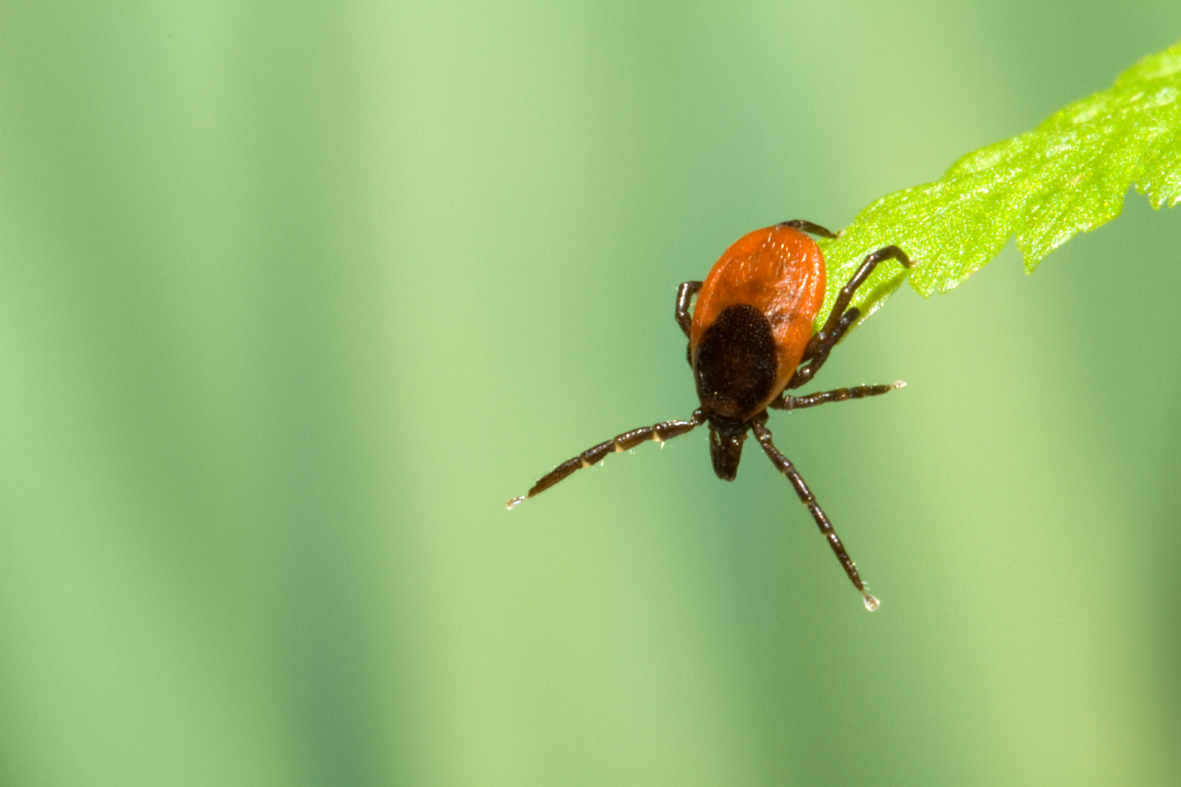
When a Davos farmer told SLF biologist Anne Kempel that he had been finding ticks on his cows for several years, the conversation prompted her to formulate the following research question: To what elevation has the tick’s range shifted as a result of climate change? Older studies found ticks at elevations of up to 1,070 metres above sea level, but they have recently been recorded as high as 1,890 metres. At the same time, ticks have extended their range several hundred kilometres northwards over the past 40 years. Knowing exactly where ticks and the pathogens they carry can be found is of interest to both farms and health authorities, which is why the TickTrack project aims to generate as much data as possible this summer.
How high up do ticks now live? 
Kempel and her team are carrying out a five- to ten-minute tick survey in August and September and are inviting residents of all villages and those living at all elevations across the canton of Graubünden to take part. The survey asks about leisure activities, sightings of ticks on people, pets and livestock, and changes in sightings over the past ten years. “We hope to use the survey to find out how the situation has changed over time, as there is no historical data on tick distribution,” explains Kempel. To map the spread of ticks as precisely as possible, the research team needs observations and reports from all elevations. Even if no ticks have been found, this is still valuable information for the SLF.
Links 
- Survey in English, German, Italian and Romansh
Kontakt 
Copyright 
WSL and SLF are making image and audio material available free of charge for use in press coverage related to this press release. The inclusion of this material in image, audio, and/or video databases, as well as its sale by third parties, is not permitted.