

11.11.2026 | Jochen Bettzieche | SLF News
SLF researchers have found out why the Brienz/Brinzauls rockslide happened later than expected: an old talus slope at the foot of the slope is thought to have delayed the collapse of the rock masses by several weeks. What to look out for in similar situations in future.
- Brienz/Brinzauls rockslide: Researchers explain why the collapse happened later than expected in 2023.
- Talus acted as a brake: Talus at the foot of the slope delayed the collapse and made it harder to predict.
- Better assessment of natural hazards: The study highlights the limitations of current forecasts for unstable mountain slopes.
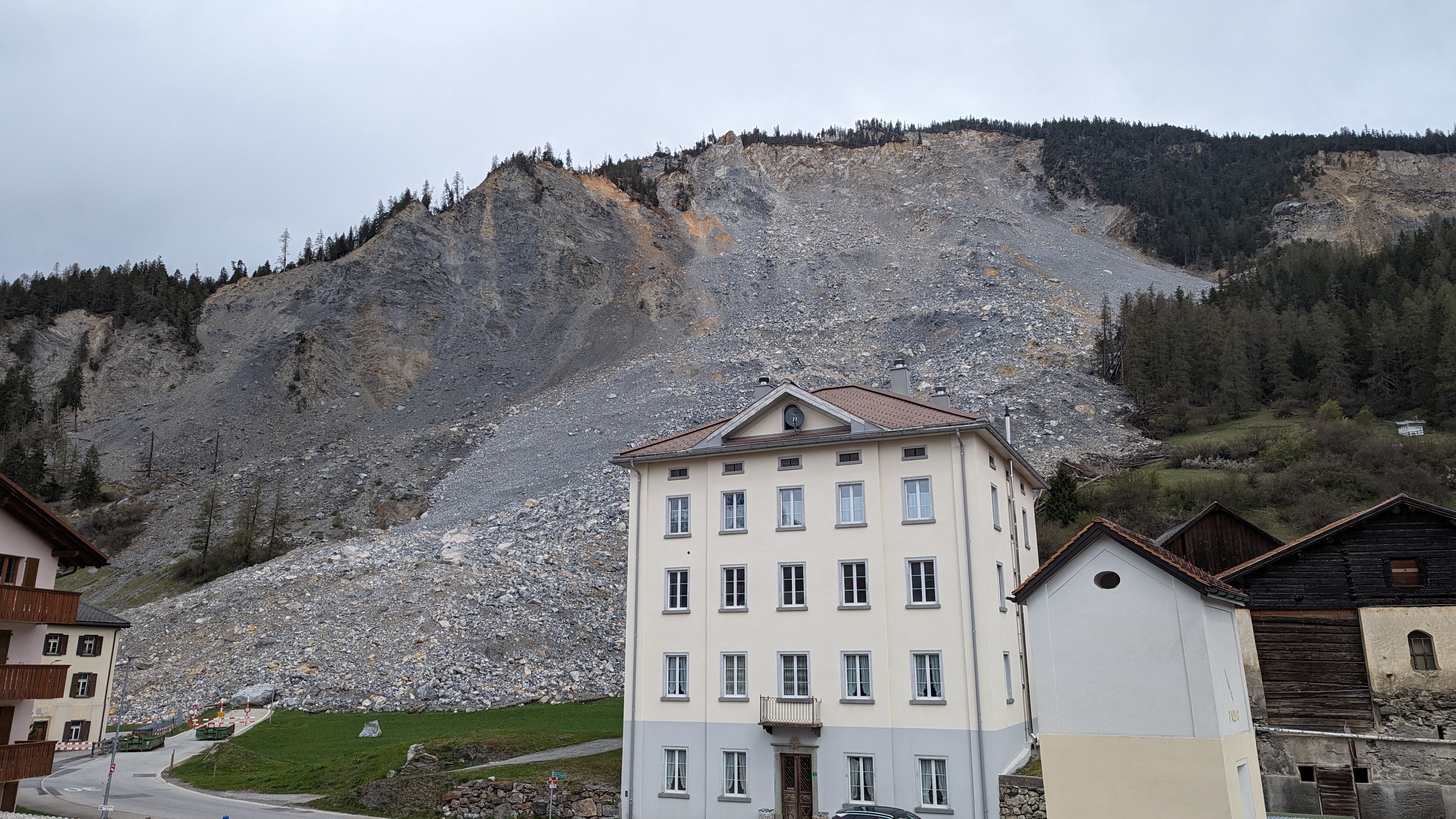
On 12 May 2023, the authorities ordered the evacuation of the village of Brienz/Brinzauls in the canton of Grisons, as a rapid slide of the slope above the village appeared imminent. However, it took its time. It was not until the night of 15–16 June that around 1.2 million cubic metres of rock and debris slid towards the village, narrowly missing it. A team led by Robert Kenner, an expert in alpine mass movements at the WSL Institute for Snow and Avalanche Research SLF, working with the geologists responsible, has investigated why the rock masses took so long to come down even though early warning systems had already raised the alarm: “This example is particularly relevant to how we manage natural hazards, as it shows how quickly a process can deviate from its previous or calculated behaviour.”
The unstable area of rock above the village was known colloquially as the “Insel” (meaning “island”). This was because it was moving considerably faster than the surrounding areas of the large Brienz/Brinzauls landslide, which has been known for centuries and extends from the River Albula on the valley floor high up the mountainside above the village. As early as March 2023, the Insel began to move at an accelerating rate. “Typically, a collapse is preceded by an exponential acceleration, which usually allows experts to predict accurately when the event will occur,” explains Kenner. The reason the collapse happened later than expected was a talus slope at the eastern foot of the Insel, into which the unstable rock mass slid.
A brake on the slope 
This talus slope slowed the Insel’s movement, but not uniformly. The braking effect of the talus changed over time. The reason for this was thrusting. Above Brienz/Brinzauls, the Insel initially pushed the uppermost part of the talus slope over the material beneath it, gradually slowing the acceleration of the rock mass. After a few days, a new sliding surface developed further down the slope within the talus slope, so that the Insel’s acceleration temporarily increased again. This process of shifting onto a new sliding surface further down the slope was repeated several times.
The researchers simulated the process on a computer (see video). This showed that whenever a new sliding surface formed within the talus, the braking effect weakened, and the Insel could therefore accelerate more rapidly for some time. They observed these fluctuations in acceleration from early March to mid-June. “Precise forecasts of when the slope would fail were therefore hardly possible,” explains Kenner.
Limitations of commonly used approaches 
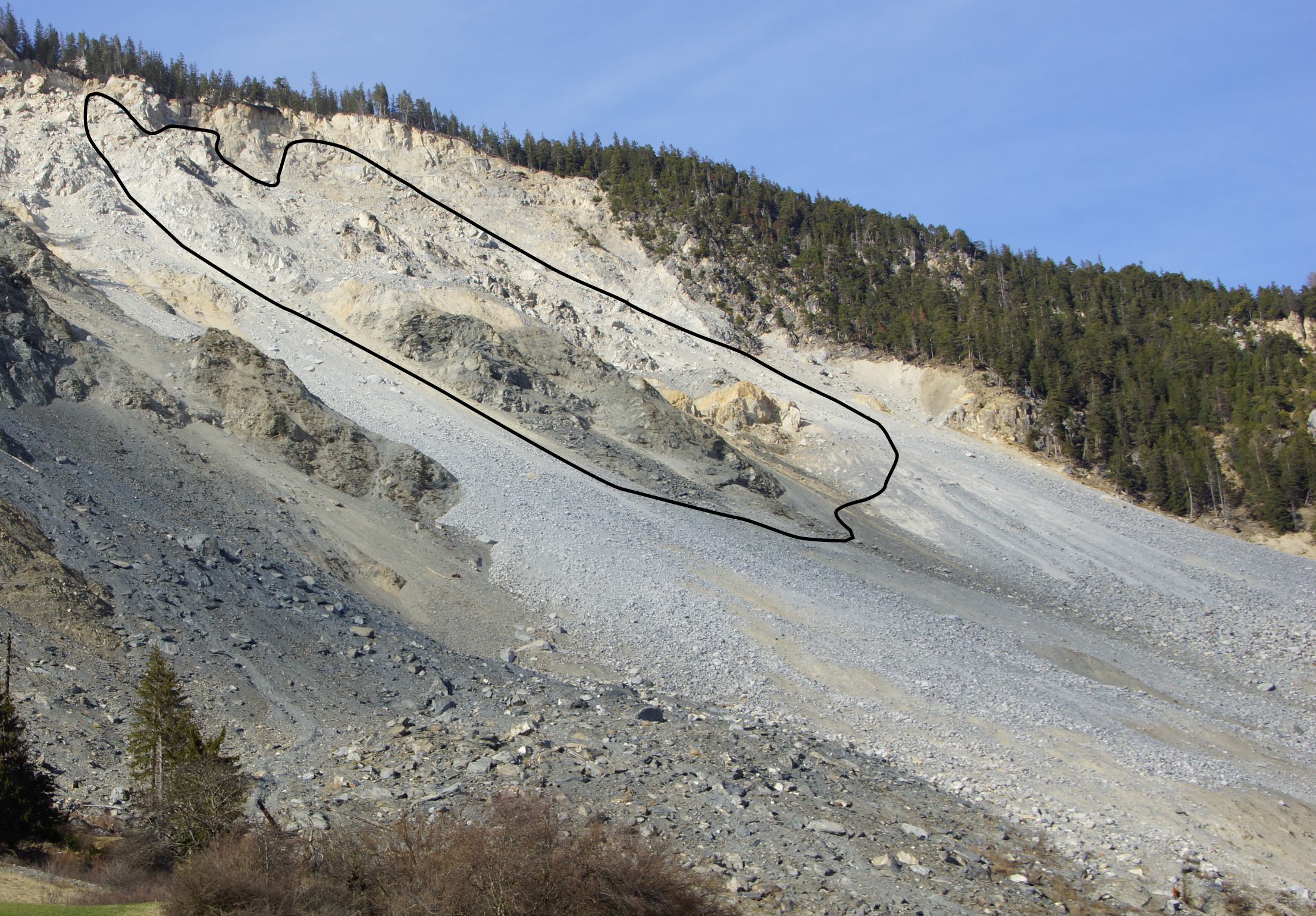
It was not until the morning of 15 June 2023 that this pattern changed. As only the eastern part of the Insel slid into the talus slope, while the western part did not, the western part began to pull on the eastern part. This eventually caused the western part to break away. The eastern part then came to a halt, as its mass alone was no longer sufficient to push forward the talus beneath it. However, the rest of the Insel accelerated sharply and flowed towards the village as a debris flow at 11.38 p.m. on 15 June 2023.
“This example highlights the limitations of commonly used approaches to predicting when such an event will occur,” says Kenner, summarising the study’s findings. One important finding, he adds, is that, in critical situations, particular attention must be paid to the buttressing effect of talus deposits at the foot of a rock face. In Brienz/Brinzauls, the timely evacuation reduced the risk posed by such an unpredictable situation, he concludes.
Links 
Contact 
Collaborations 
The SLF collaborated on the study with the following organisations (in alphabetical order):
- BTG Büro für Technische Geologie
- Forestry and Natural Hazards Office Grisons
Copyright 
WSL and SLF provide image and sound material free of charge for use in the context of press contributions in connection with this media release. The transfer of this material to image, sound and/or video databases and the sale of the material by third parties are not permitted.