

26.05.2026 | Delia Landolt | SLF News
From the Kleines Nesthorn to Pizzo Cengalo, the Alps appear to be crumbling. Permafrost researcher Robert Kenner has penned a summary explaining the role that thawing permafrost and melting glaciers play – or don't play – in this process.
- Rock slope failures are not caused solely by thawing permafrost: they also require geological weak zones, steep slopes and water within the rock.
- Permafrost is not a 'glue': it acts more like a sealant, with water infiltration and ice pressure able to destabilise rocks over time.
- Climate change increases risks in high alpine regions: small rockslides are clearly on the rise, while large rock avalanches remain relatively rare despite a possible increase in their frequency.
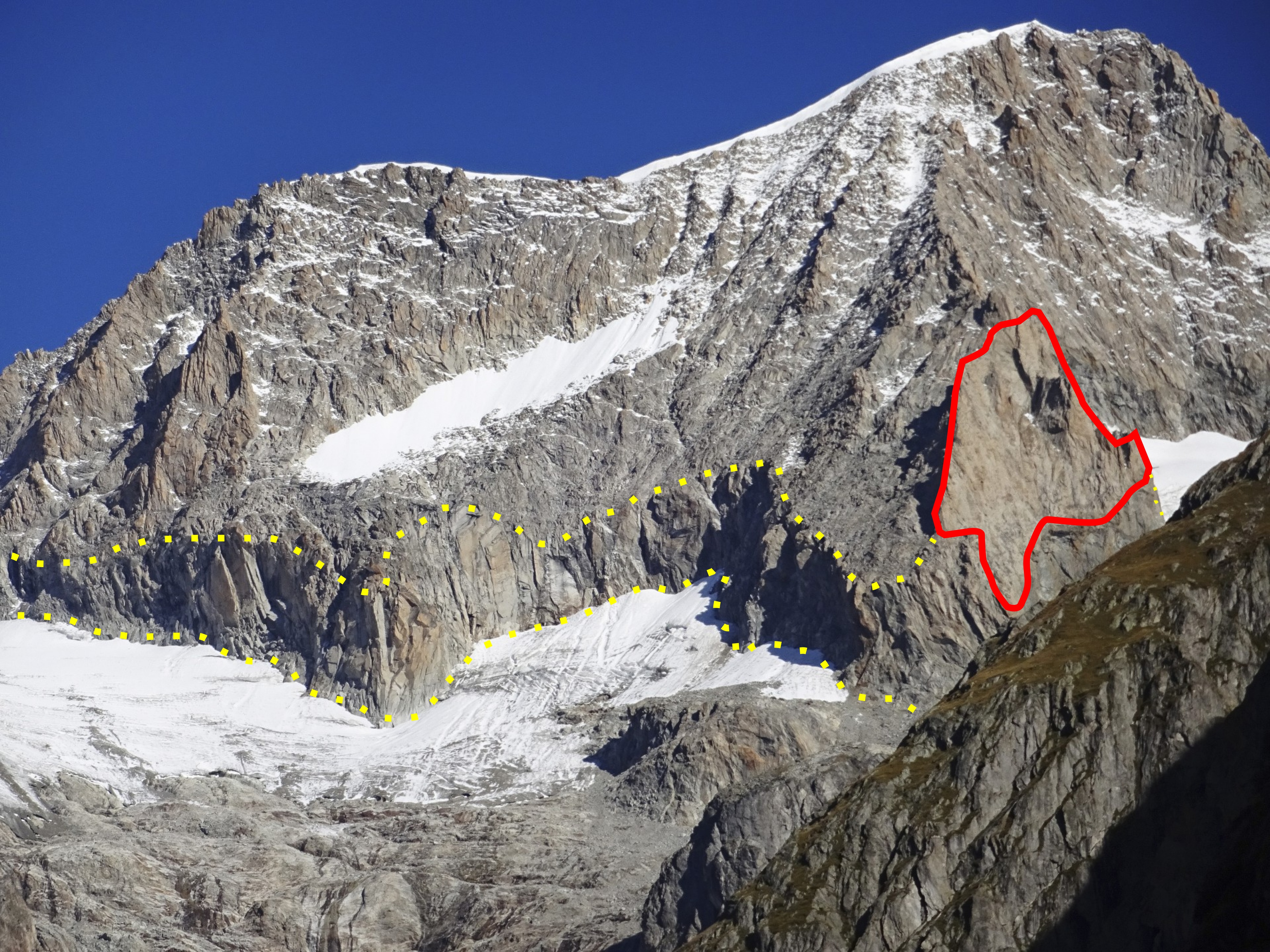
Robert Kenner, what causes a rock slope failure?
For a section of rocky mountainside to collapse, there has to be a suitable combination of geological structure, rock properties and topography. Every mountain has weak zones. If these are aligned in the wrong way, gravity can cause cracks to form in them over time. Then the rock face must be steep enough and there has to be enough space for it to start moving at all. In the Alps, this space has mainly been created by glaciers eroding the base of rock slopes. As a result, some slopes have become too steep to remain stable in the long term.
You write that permafrost isn't the glue that holds the Alps together. So what is it?
Permafrost can affect mountains in various ways. Permafrost ice can actually stabilise small amounts of loose rock, but when subjected to significant stresses, such as those found on large mountain slopes, ice behaves plastically and yields to the pressure. Over long periods, permafrost even has a destabilising effect, as the slow growth of ice in the fractures contributes to rock fragmentation and erosion. So the image of a glue holding the mountain together isn't the right one in the case of major slope instabilities. If the permafrost is cold enough, it acts more like a sealant for the mountains, preventing water from penetrating into them.
What does water do if it gets inside a mountain?
The water in the fractures can cause high pressures to build up, resulting in significant stresses within the rock. In some cases, the water may freeze again at greater depths, creating ice pressures of up to 10 Mpa – equivalent to being 1,000 metres underwater. At Spitze Stei in Kandersteg, we're seeing a different situation: some types of rock can be weakened by water infiltration, and that's what's happened here with a layer of marl at the base of the rock mass. At the same time, as the snow melts each summer, high water pressure builds up inside the mountain, causing the slope movement to accelerate.
Are there other examples linked to thawing permafrost?
Following the rock avalanche on Pizzo Cengalo in 2011, massive ice wedges were revealed in the detachment zone, indicating the long-term destructive impact of permafrost. High water pressures also then built up in this area. In a subsequent detachment zone, formed in 2017, the water column in the fractures was found to be over 80 metres high in some places. Water also played a role in the Piz Scerscen rock avalanche in 2024: the ice cap on the mountain had warmed up so much before this that, for the first time in a long while, meltwater flowed through it and into the mountain. It then refroze inside the rock, which was still cold.
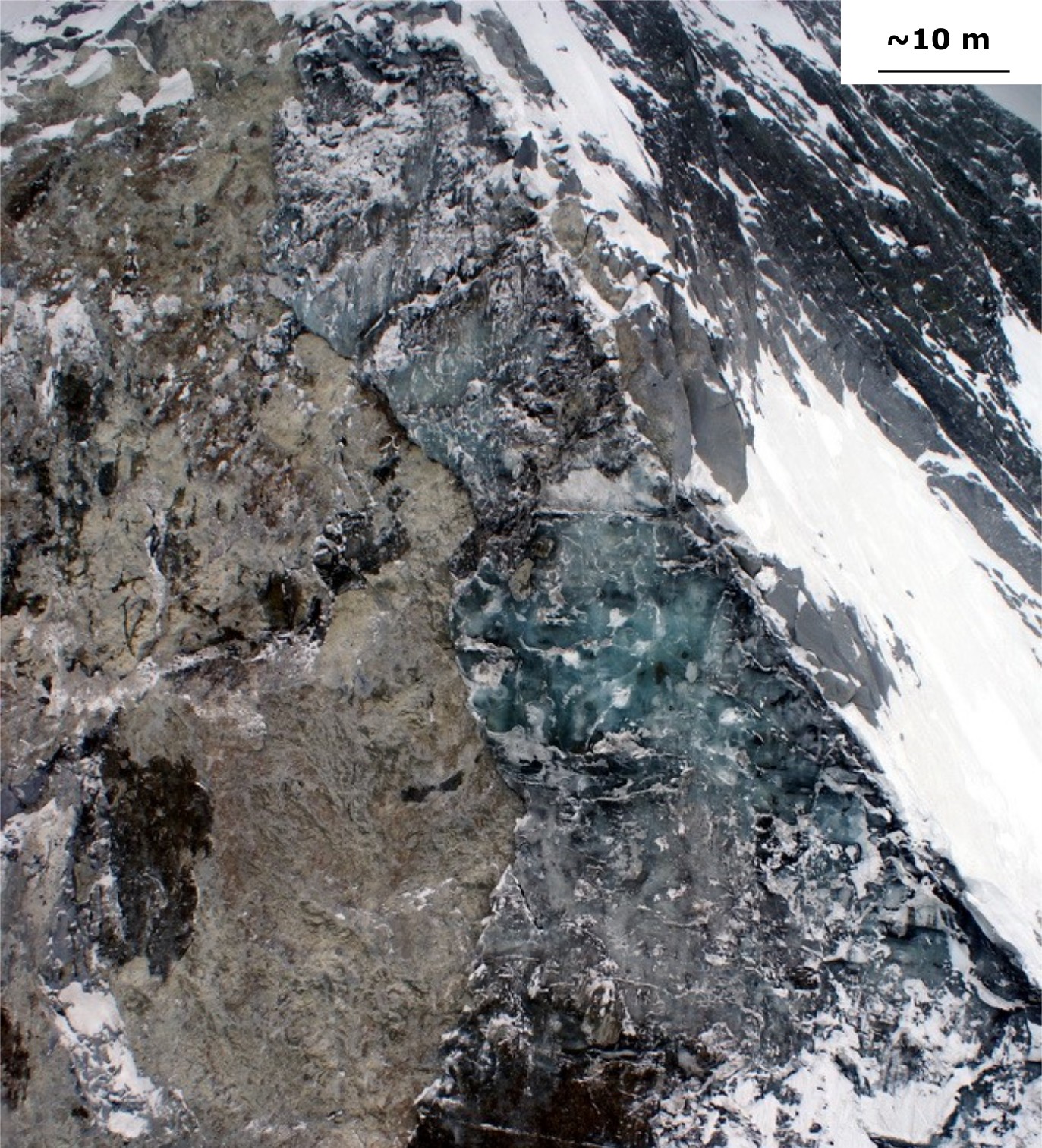
Is that also what's happening on the Kleines Nesthorn above Blatten?
So far, we haven't found evidence of any of those processes on the Kleines Nesthorn. In the detachment zone, we discovered a dry, largely ice-free rock mass that had been severely fragmented by geological processes. Presumably, the permafrost here was still so cold that hardly any water has penetrated so far. The rock structure was also so badly damaged that water pressure couldn't have built up even if thawing did occur. Consequently, there hasn't been a major rock slope failure either. Instead, the fragmented material has fallen onto the glacier in countless small chunks. This glacier may also have been the cause of the slope instability. Over many millennia, it has eroded the foot of the slope, resulting in a visible steepening here. Like a pile of sand whose base is dug away, this may eventually lead to the collapse of the material above.
Are large rock avalanches now happening more often as a result of global warming?
This is likely to be the case in permafrost regions, i.e. high mountain areas above around 3,000 metres above sea level, but the frequency remains uncertain. No one knows exactly how widespread these destabilising processes are or how many slopes are susceptible to them. As there was no systematic recording of rock slope failures in high alpine regions for a long time, we don't yet have any statistical evidence. While small rockslides and rockfalls are clearly increasing as a result of global warming, there are many indications that, despite an increase in their frequency, large rockslides and rock avalanches will remain rare events in the future.
What is … permafrost?
Permafrost is soil, rock or debris that is permanently at a temperature of 0 degrees Celsius or below. In the Alps, it extends to a depth of several hundred metres, while the surface – known as the active layer – thaws to a depth of around two metres every summer. Approximately five per cent of Switzerland's land area is covered in permafrost, specifically at elevations above 2,500 metres. Its presence is indicated by landforms such as rock glaciers and hanging glaciers.
Links 
- Tiefgründige Felsbewegungen im (vergletscherten) Permafrost: Das dünne Eis des Kenntnisstands (only in german)
Robert Kenner's article appeared in the Swiss Bulletin for Applied Geology in February 2026. - Permafrost
Kontakt 
Copyright 
WSL and SLF provide image and sound material free of charge for use in the context of press contributions in connection with this media release. The transfer of this material to image, sound and/or video databases and the sale of the material by third parties are not permitted.