

In this interview, SLF forest ecologist Alessandra Bottero explains the impact of forest fires on bark beetles, how to prevent mass infestations and why it is vital to carry out targeted monitoring after a fire.
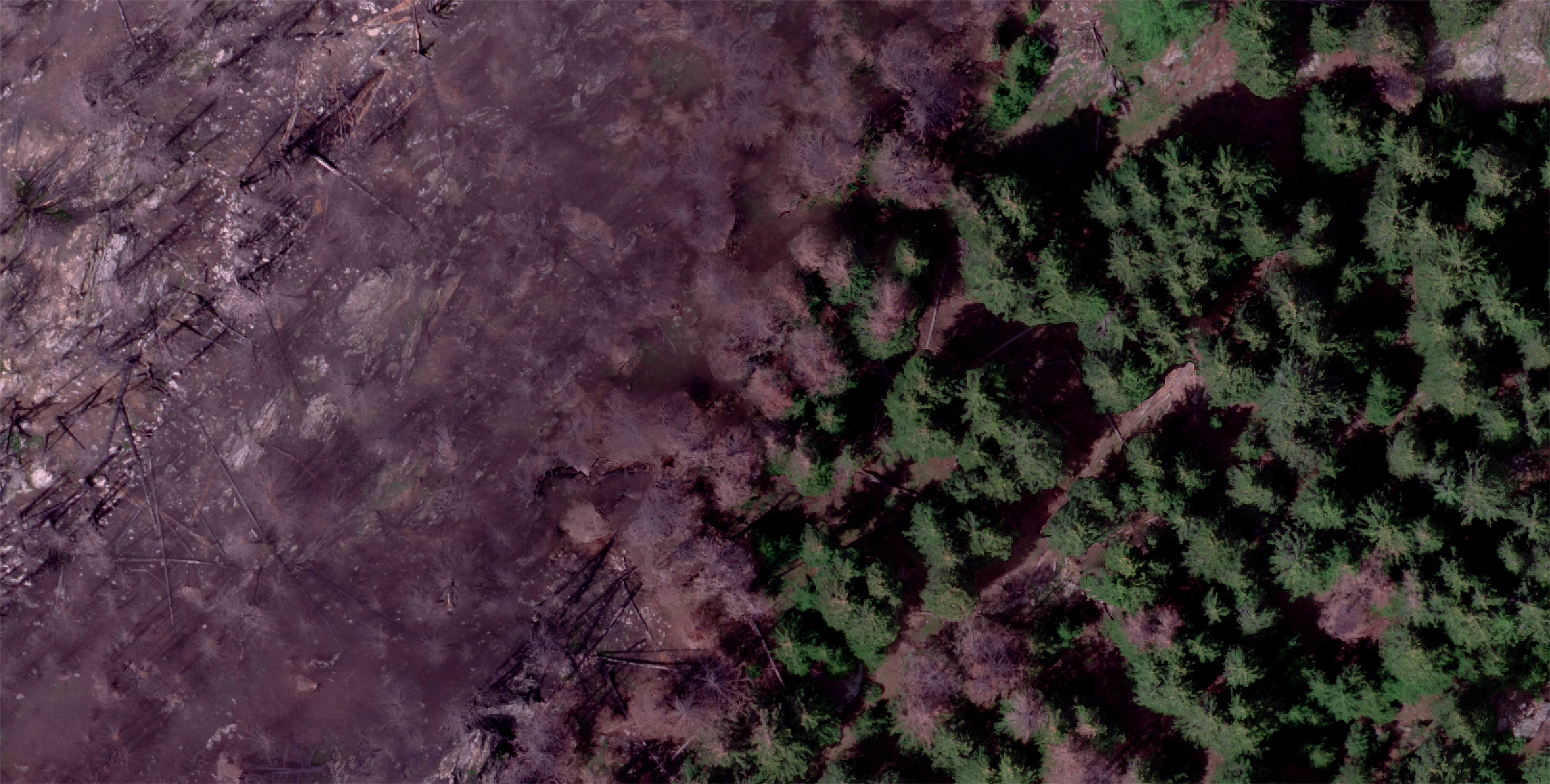
- Bark beetles after a forest fire: Weakened spruce trees at the edges of fires can provide new beetle breeding sites.
- Bark beetle infestation: A mass outbreak only happens when a number of factors coincide.
- Climate change: Heat, drought, storms and forest fires can increase the bark beetle infestation risk in spruce forests.
Miss Bottero, do forest fires deprive bark beetles of their habitat?
Not necessarily. In severely burnt areas, there usually aren't any suitable host trees left for bark beetles. The situation may be different, though, at the edges of burnt areas. Spruce trees that have been weakened by heat, drought and root damage often survive there. These trees are more susceptible to infestation and can provide suitable breeding material for European spruce bark beetles, but it's by no means certain that this will actually result in an outbreak. A number of conditions must be met at the same time for this to happen.
What are they?
Beetles must colonise weakened trees while their defences are still low. The trees must also have enough intact phloem (living tissue) beneath the bark for larvae to develop. Also, natural predators must not substantially reduce bark beetle numbers. Only the combination of these factors can drive a significant increase in the population.

Can anything be done to prevent bark beetles from establishing themselves on a large scale at the edges of the burnt areas?
It's particularly important to carefully monitor the forest edges after a fire. Weakened or newly infested trees should be detected as early as possible so that, if necessary, they can be removed in time to stop the beetles multiplying en masse. That said, large-scale clearance of the forest edges isn't usually necessary or useful. What is crucial is targeted and rapid action.
If the frequency of forest fires in Europe keeps rising because of climate change, will bark beetles find a growing number of stressed trees to colonise?
It's possible. In general, we expect droughts to increase and disturbances such as forest fires, storms and bark beetle infestations to become more frequent or intense in the future. Higher temperatures can create particularly favourable conditions for spruce bark beetles by accelerating their development, while drought stress weakens the defence mechanisms of spruce trees. Forest fires are one of several factors here that can put extra stress on trees. As a general rule, the more weakened spruce trees are, whether because of drought, fire or other impacts, the more susceptible they are to spruce bark beetle infestation.

Links 
At the SLF, researchers are carrying out several projects to investigate the behaviour of bark beetles and what measures can be taken to protect the forest from these insects:
Contact 
Copyright 
WSL and SLF are making image and audio material available free of charge for use in press coverage related to this press release. The inclusion of this material in image, audio, and/or video databases, as well as its sale by third parties, is not permitted.