18.02.2026 | Jochen Bettzieche | SLF News
SLF researchers have shown that cracks in weak layers of snow propagate faster than expected. New experiments provide vital insights for avalanche forecasting and risk management – and confirm a recently formulated theory.
- High speed: Cracks in the snowpack propagate faster than previously thought – namely at a speed of more than 100 metres per second.
- New insights for models: The results may help to improve avalanche size and hazard assessment forecasts.
- Extensive field research: Experiments in Davos back up theory – further studies on natural avalanches needed.
Since 10 January 2026, the WSL Institute for Snow and Avalanche Research (SLF) has received reports of hundreds of 'whumpfs' (i.e. sounds indicating a collapse in the snowpack) and of remote triggering events – unmistakable signs of a critical avalanche situation involving a weak snowpack. A whumpf is where a snow sports enthusiast causes a fracture in a weak layer of the snow, which within seconds propagates as a crack across the terrain. If the crack reaches steep terrain, this may trigger an avalanche – a remote triggering event. Previously, it was assumed that such cracks propagate at speeds of between 20 and 80 metres per second. SLF researchers wanted to learn more. They have now experimentally demonstrated that cracks propagate faster than expected, even exceeding the previously assumed theoretical boundaries for this process in snow.
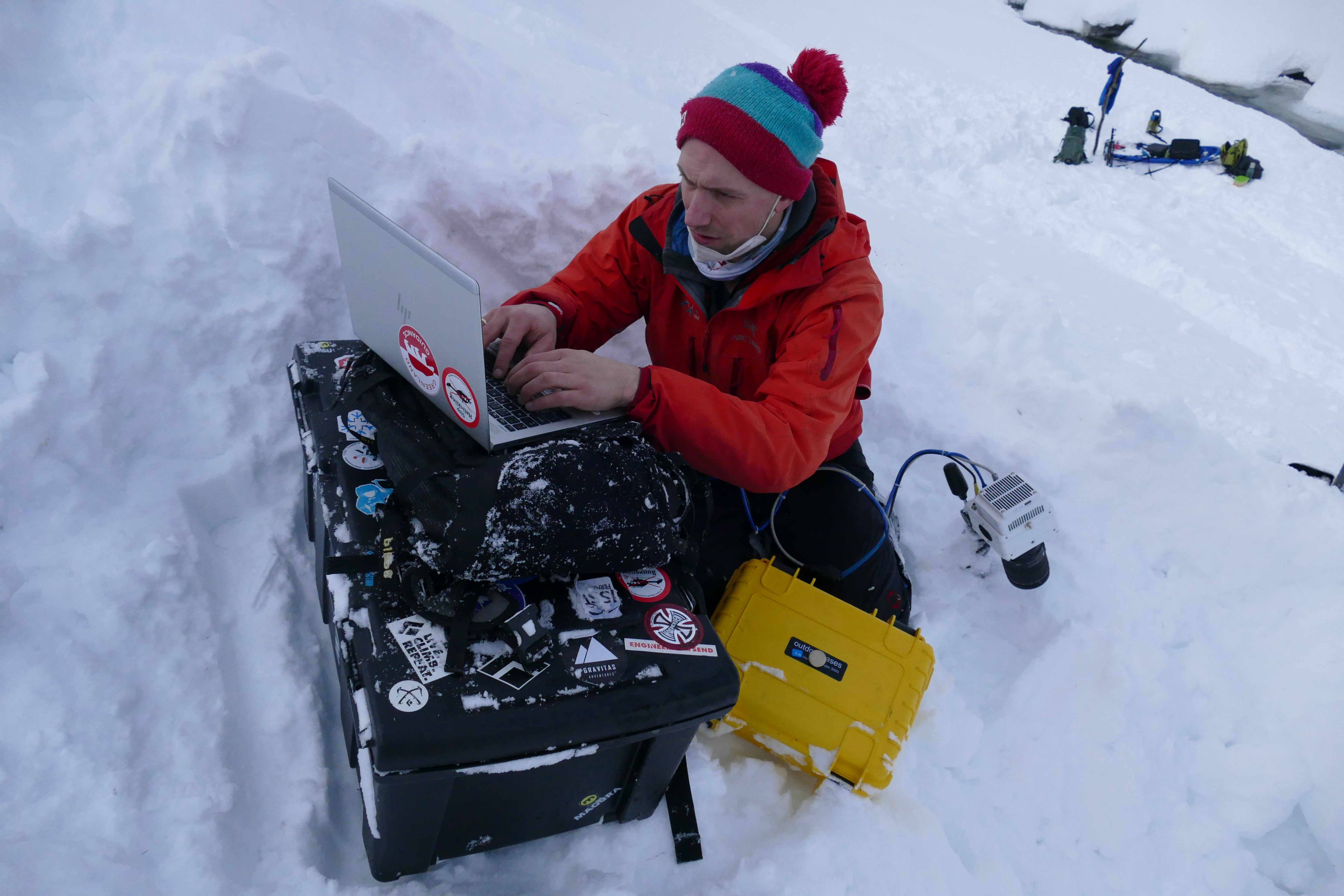
For a number of years, SLF scientist Bastian Bergfeld has been trying to initiate cracks and, ideally, trigger and measure avalanches. Just finding a suitable location for his experiments took more than a year. He needed an outdoor research site with natural snowpack in winter and a gradient of more than 30 degrees. He explains: “The site couldn't be on dangerous terrain though, otherwise an avalanche would sweep away the equipment and the researcher.”
Theoretical boundaries exceeded 
He finally found what he was looking for on the outskirts of Davos Platz. On his experimental slope, he tried to preserve potential snowpack instability in some large fields. "I was there whenever it snowed, and I cleared the snow away from around the outside," recalls Bergfeld. Then he would just have to hope that the snowpack would become unstable – and that the avalanche would not be triggered prematurely by some other external influence. "There were even times when I triggered a release simply by approaching the location after snowfall, but it couldn't propagate into the isolated fields," says Bergfeld.
However, when everything went well, he was able to deliberately trigger 'avalanches' and record them from different angles using high-speed and other cameras. This revealed that cracks in weak layers propagate slowly at first. However, once they reach a critical distance of between five and six metres, the speed builds up, even exceeding the theoretical boundaries. The propagation speed increased from 50 to 130 metres per second. Computer models and individual observations had suggested this behaviour. The observed acceleration is probably due to the force of gravity on the slope. "Basically, the crack in the weak layer propagates faster than was explicable by previous models," explains Bergfeld. However, this behaviour can also occur in other materials. "Earthquake research had already shown that higher crack propagation speeds are possible as well," says Johan Gaume, leader of the Alpine Mass Movements research group at the SLF.
Bergfeld's experiments confirm the findings from the computer models, but he also sees a need for further research, because his avalanches happened under controlled conditions, but the situation is different out in the field. Every slope has its own particular characteristics. "We don't yet know how often this rapid crack propagation occurs in the natural environment and what role the properties of the snowpack play in this process," he says.
This means the implications of the new insights for avalanche formation are not yet completely clear. How effectively a crack propagates in a weak layer determines, for example, how big an avalanche will be. It could therefore be that rapid cracks are less likely to lead to crack arrest, which would tend to make avalanches bigger. If the conditions for rapid crack propagation were better understood, the expected avalanche size could be better estimated, which would be very useful. This is because the size of an avalanche is crucial not only for working out the danger level in the avalanche bulletin, but also for assessing the risk to property, i.e. for the risk management of vulnerable infrastructure.
Links 
Contact 
Copyright 
WSL and SLF provide image and sound material free of charge for use in the context of press contributions in connection with this media release. The transfer of this material to image, sound and/or video databases and the sale of the material by third parties are not permitted.