

30.09.2025 | Christian Rixen | Daniela Heinen | SLF News
How the SLF is investigating the long-term effects of global warming on Alpine flora.
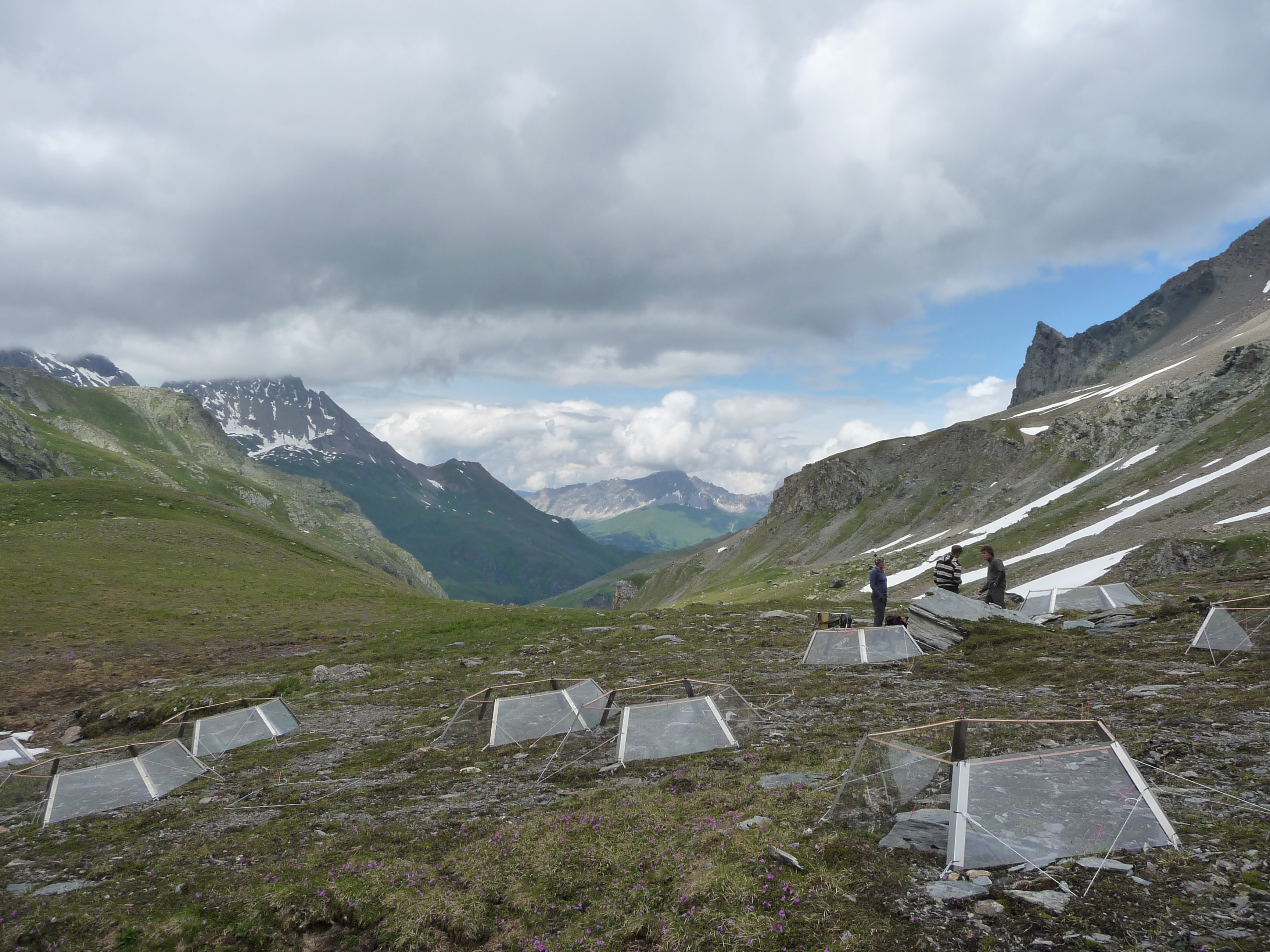
In Val Bercla above Mulegns, hexagonal plastic structures dot the mountain landscape. They are part of the International Tundra Experiment (ITEX), a major network studying the effects of climate change. These structures, known as open-top chambers, heat the air inside by around 2 degrees Celsius compared to the outside temperature, simulating global warming.
Biologist Christian Rixen from the WSL Institute for Snow and Avalanche Research (SLF) in Davos has been looking after the Val Bercla field site since 2009. It was originally established over 30 years ago. Rixen explains why ITEX takes into account Arctic as well as Alpine regions: “Strictly speaking, ‘tundra’ refers to the treeless area of the Arctic. However, a tundra shares a lot of similarities with high alpine areas.” Many of the same plant species are found in both areas and the conditions are similar, with sustained snow cover and low temperatures. For example, purple saxifrage grows both on the Dom in the Valais Alps at 4,546 metres above sea level and on the northern tip of Greenland, only 700 kilometres from the North Pole.
What makes ITEX special is that all sites around the world operate according to a uniform protocol. This makes it possible to compare data and identify common trends. The temperature difference in the chambers usually remains constant, except during strong winds. This simple, cost-effective design means that test facilities can remain in place for decades. Among other things, data is collected on which plant species occur on the field sites, how frequently and how they change over time, e.g. not only whether a species is becoming more prevalent or is disappearing, but also whether it is growing larger.
Cold-adapted alpine plants react very slowly to temperature changes. “They are very, very cautious. This has its advantages, for example in the case of late frosts, but it also makes them vulnerable to competition from faster-growing species,” explains Rixen. In Val Bercla, for instance, specialists such as purple saxifrage are declining and shrubs such as small willows are spreading. Nevertheless, the alpine habitat is relatively well buffered, thanks in part to its topographical diversity – from sunny ridges to shady hollows. “Our mountains are high, so many species can still move to higher altitudes,” notes Rixen.
But it’s not just about what is visible above ground. Cold-climate soils store huge amounts of carbon. When warming changes the composition of vegetation, it also affects soil activity – with consequences for the global carbon footprint. “What we cannot yet quantify precisely is how much carbon we gain or lose through these processes,” says Rixen. “But we know that this question is hugely important.”
In Rixen’s view, the fact that this biological research is being carried out in Davos is extremely significant: “The SLF is much more than ‘just’ an avalanche research institute. It’s part of the Swiss Federal Institute for Forest, Snow and Landscape Research WSL. Our group in Davos conducts research on vegetation, alpine meadows, protection forests and the impact of climate change on alpine flora.”
This article first appeared in the Davoser Zeitung on 30 September 2025.
Contact 
Links 
Projects 
Copyright 
WSL and SLF provide image and sound material free of charge for use in the context of press contributions in connection with this media release. The transfer of this material to image, sound and/or video databases and the sale of the material by third parties are not permitted.