

Forest fires: FAQs and feature 
The WSL and SLF regularly receive enquiries about forest fires, ranging from the effects of climate change to the situation in Switzerland. Here our experts answer the most frequently asked questions.
Contents 
Forest fires: the basics 
What is a forest fire?
A forest fire is any fire that burns out of control and affects or engulfs a woodland area. This may involve a single tree, multiple trees or even large areas of woodland or forest.
The trees do not necessarily burn completely. There are several main types of forest fire: some fires affect the tree canopies, others burn the litter layer near the forest floor, and some burn humus and roots in the topsoil.
What causes forest fires?
Human activity is the main cause of such fires in the Mediterranean region and Switzerland. This does not necessarily mean that a fire was started deliberately (arson). More often, such fires are caused by carelessness in already precarious conditions. This might involve a fire on the ground, or charcoal from a barbecue that was not properly extinguished. A recurring cause is ashes emptied onto a compost heap when people leave their accommodation in the countryside like a chalet. The charcoal embers in these ashes may continue to smoulder for many hours. If the wind picks up, they may start a forest fire. Any work equipment that produces sparks, such as a milling machine, can also pose a danger, as just a few sparks may be enough to ignite a forest fire when conditions are highly conducive to this.
In Switzerland, there is also just one other, natural cause, which only occurs in the summer months, but a significant one as in dry summers it can trigger half of these fires, and that is lightning.
How do forest fires develop?
Forest fires rarely develop from a single extreme event. As a rule, multiple factors, occurring either sequentially or simultaneously, play a role: the availability of sufficient combustible material (fuel) such as trees, shrubs or other plants; dry conditions; and an ignition source such as a discarded cigarette, a spark or a lightning strike.
Such situations arise under specific conditions. Heavy precipitation in late winter and spring leads to plants sprouting and growing well. Any heatwave following such a period of strong vegetation growth dries out the vegetation involved, increasing the forest fire danger. Note here that it is not the heat itself but rather the resulting lack of atmospheric humidity and soil moisture that exacerbates fires.
In spring and winter, there is also a direct link with snow conditions. Prolonged periods of drought lead to low snowpack in Northern and Eastern Europe and the Alps. Combined with strong winds, this results in snow-free areas where vegetation lies dormant at this time of year, making it dry and highly flammable. This applies especially to forests with deciduous trees, as the sun can then shine directly through their leafless canopies onto the litter layer on the forest floor. This means that forest fires can develop and – fanned by the wind – quickly spread.
Forest fires and climate change 
What effect will climate change have on the forest fire danger in the decades ahead?
Almost every year this decade has seen record-breaking forest fires in Europe. Climate projections clearly show that extreme events such as droughts and heatwaves will become more frequent because of global warming. As a result, the forest fire danger will increase.
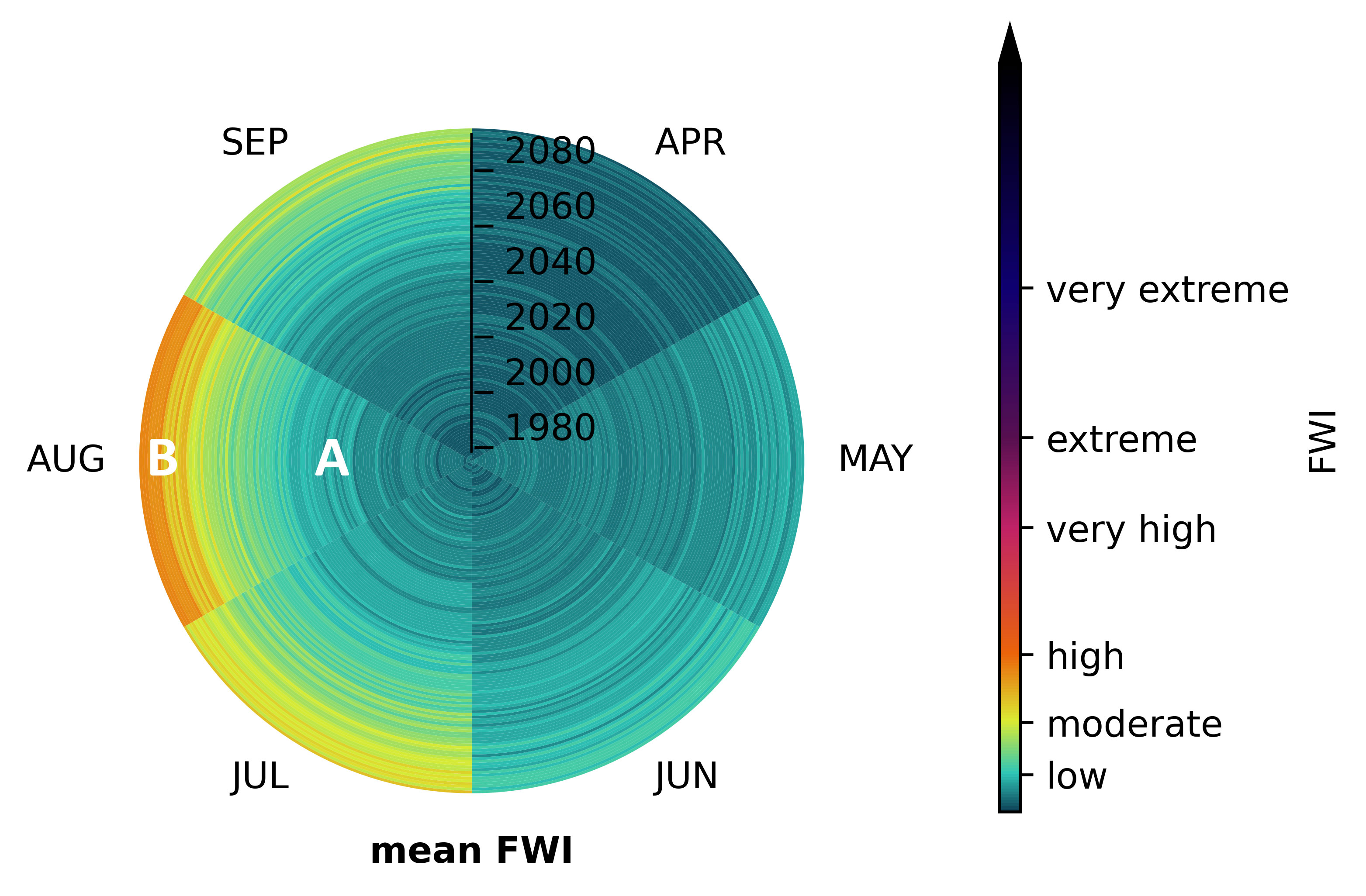
The number of days when the forest fire danger level is at least high will more than double by the end of the 21st century. Researchers expect that by 2100 it will be high even in regions where it remains very low today. Forecasts show that the potential danger will continue to increase. From no later than 2040 onwards, the meteorological forest fire danger will rise even more rapidly than today. Weather conditions capable of triggering forest fires, which today occur only once every sixty years, will do so on average every ten years by 2090 (see the chart). The projections also show that favourable weather conditions for forest fires will occur earlier in the year than today.
What can humans do to counter the danger of forest fires that is growing due to climate change?
The most efficient strategy would be to combat climate change and limit global warming as much as possible so that the forest fire danger stops rising each year.
On top of this, preventive measures are essential. Even regions with a temperate climate will need to prepare for forest fires in the future. Such preparations range from providing reservoirs for firefighting water and ensuring the availability of firefighting helicopters to erecting warning signs and running information campaigns alerting people in the area to the danger. These campaigns are useful all year round because whereas in summer, awareness of forest fires and preventive measures in general is high, the situation is different in winter and so more information is urgently needed.
Forestry can also contribute to these efforts, as the different fuel properties of tree species can affect how easily fires start, spread and burn.
A key factor is the moisture content of deadwood. Thick tree trunks or branches, which might be partially covered with soil, remain moist for a long time. They are more likely to inhibit a fire than to fuel it. However, thin branches, bark, leaves and needles dry out quickly in windy conditions and high temperatures. Branches and fine twigs on the ground may increase the intensity of fires, make them spread faster in the first few minutes and ultimately hinder the fire brigade's crucial initial intervention or even lead to its failure.
Progressive forest management (silviculture) takes these factors into account. In forests where many different tree species grow and create a structured, closed canopy, the ground is well shielded from sunlight. This lowers the temperature and increases the atmospheric humidity, meaning that it takes a long time for deadwood to dry out. Forests managed in this way are less susceptible to fire than monocultures, for example.
What non-silvicultural measures can be taken to reduce the risk of forest fires?
The landscape also plays a significant role. Open agricultural land between forests and villages stops the fire before it reaches any settlements. If these areas are abandoned and turn into scrubland, the danger comes right up to homes. The same applies when buildings are constructed right on the edge of a forest or within a forest.
It is therefore important to have a strategy that looks decades ahead and incorporates landscape management and planning. Such an integrated forest fire management strategy means adopting a holistic approach to forest fires – from prevention and control through to restoration of the affected areas and the protective function of the forest.
Given that forest fires and their impacts do not stop at national borders, international cooperation and cross-border collaborations also play a vital role. This applies not only to international assistance for tackling existing forest fires, but also to prevention of such fires in the first place.
What does nature itself do to combat forest fires?
Prolonged rainfall can ensure that the soil and vegetation have enough moisture to significantly reduce the forest fire risk, in a way that a single shower or thunderstorm cannot.
Do the areas being affected by forest fires now differ from those in the past?
Until now, the European forest fire hotspot has been Southern Europe. However, severe droughts have also led to large-scale forest fires in Central and Northern Europe in recent years, most notably 2022 and 2026. This suggests that conditions conducive to fires are now also found in regions which had previously been less affected due to sufficient moisture. This shows the urgent need for a Europe-wide perspective when it comes to forest fire research and adaptation.
Are certain elevations particularly at risk of forest fires?
Climate change is expected to mean that in the future, forest fires will also start occurring at higher elevations that have been less affected until now. This trend can only go so far, though, because of the natural limit imposed by the treeline. However, an investigation of the meteorological factors that influence forest fires also shows that most of these factors are more pronounced in mountain regions than in non-mountain regions.
In Switzerland, though, fires caused by lightning strikes have long been a common occurrence at higher elevations.
What are the impacts of forest fires on protection forests?
Depending on their severity, forest fires may impair the protective function performed by forests. Trees damaged by forest fires are less able to hold back rockfalls and avalanches. Not only this but during heavy rainfall, severely burnt areas are more susceptible to erosion and debris flows until the vegetation has recovered. When fire destroys a protection forest, it means that lower-lying settlements or infrastructure that had been sheltered by the forest will face years, if not decades, of exposure to natural hazards.
How can the forecasting of forest fires be improved in the future?
One approach is to detect at an early stage when the weather begins to deviate from its usual seasonal pattern. This enables various drivers of forest fires that are already outside the norm to be identified before a fire occurs. Adopting this approach makes it possible to assess the level of danger more accurately at an early stage.
Forest fires in Switzerland 
Has the number of forest fires in Switzerland changed?
While comprehensive historical data is not available for Switzerland as a whole, such data is available at least in part for the Alps, Valais and Grisons, as well as for Ticino. In Ticino, a 120-year statistical record shows that forest fires increased sharply in both number and area between 1955 and 1980. This post-war period saw a decline in traditional farming activities on steep mountainsides, leaving this uncultivated land highly flammable. Only in the 1990s did the number of forest fires in Ticino fall again, due to the ban on burning garden waste outdoors.
What is special about the forest fire situation in Switzerland?
Individual forest areas in Switzerland are often relatively small by European standards. The fragmented woodland on the Swiss Plateau, in particular, means that this part of the country faces hardly any risk of large-scale fires. The picture is different in the Alps and the Jura mountains, with their larger, contiguous forest areas.
In Switzerland, the topography – in other words, the forms and features of the land surface – also affects the occurrence of forest fires. Fires develop extremely quickly on steep slopes because the heat from the fire on a steep, wooded slope creates its own thermals. Propagation speeds can then reach up to 70 kilometres per hour. The exponential dynamics involved here mean that once a fire reaches a certain intensity, it becomes virtually unstoppable. Once tree canopies start burning, there is no hope of successfully fighting the fire.
However, one crucial advantage of a fire occurring on a gradient rather than in a flat region is that fires travel upwards, and so away from settlements, which are usually in valleys. This means that people and infrastructure in mountain regions are less at risk than they otherwise would be.
The 1973 Forest Fire Year
Just how devastating fires can be, even in Switzerland, was demonstrated in Ticino in 1973: over the course of that year, around 73km² of forest – equivalent to almost 5% of the canton's total forest area – was destroyed by fire. One large fire alone, in Val Colla, saw 1,600 hectares go up in flames.
Has Switzerland taken enough preventive measures?
The cantons of Valais, Ticino and Grisons, which have always been particularly affected by forest fires, have been dealing with this issue for many years. In Ticino, there is a dedicated mountain fire brigade that specialises in such fires. The cantons have also invested in firefighting, for example building water reservoirs for helicopters and improving the training of emergency services personnel.
What should people do if they discover a fire in the forest?
First go to a safe place, and then call the fire brigade. Trying to extinguish the fire yourself could be dangerous. When a fire is out of control, conventional means will not be enough to deal with it.
Fires in forests often spread faster than people can run. In the mountains, it is best to head downhill, whilst avoiding narrow valleys where a chimney effect can cause heavy smoke to build up.
Impact of forest fires on nature 
Do forest fires have any benefits?
Forest fires do indeed have some key ecological functions. First, they destroy dead biomass, so in a sense disinfecting the forest floor. At the same time, a fire supplies young plants with vital nutrients. In addition, because more light reaches the ground after a fire, new species are able to establish themselves. Some tree and insect species have adapted to forest fires over the course of evolution and can only spread and reproduce after a fire. As a result, small-scale fires are also a key driver of greater biodiversity.
What do forest fires mean for bark beetles?
In severely burnt areas, there are usually no suitable host trees left for European spruce bark beetles. However, trees often survive at the edges of burnt areas, albeit weakened by heat, drought and root damage, making them more susceptible to pest infestations. In the case of spruce trees, they can provide suitable breeding material for the spruce bark beetle.
Whether an outbreak actually occurs depends on further conditions: the beetles must not only colonise trees while their defences are still weakened, but the trees must also have enough intact phloem (living tissue) beneath the bark for larvae to develop. Moreover, natural predators must not substantially reduce bark beetle numbers. Only the combination of these factors can drive a significant increase in the population. Therefore, it is crucial to closely monitor the edges of burnt areas after a fire and to remove weakened or newly infested trees promptly to stop the beetles multiplying en masse.
Additional information 
Heat and drought: FAQs and feature 
Read all about the effects of heat and drought—on forests and more—in this FAQ.
Previous news items on forest fire research by WSL and SLF 
Scientific publications on the topic of forest fires 
- Waldbrände im Klimawandel
- Compounding preconditions of wildfires vary in time and space within Europe
- Climate change impacts on regional fire weather in heterogeneous landscapes of central Europe
- Linking the future likelihood of large fires to occur on mountain slopes with fuel connectivity and topography
Projects 
Products 
Contact 
Press office SLF:
- E-Mail: medien(at)slf.ch
- Tel. +41 81 417 01 90
Press office WSL:
- E-Mail: media(at)wsl.ch
- Tel. +41 44 739 28 39
Copyright 
WSL and SLF are making image and audio material available free of charge for use in press coverage related to this press release. The inclusion of this material in image, audio, and/or video databases, as well as its sale by third parties, is not permitted.